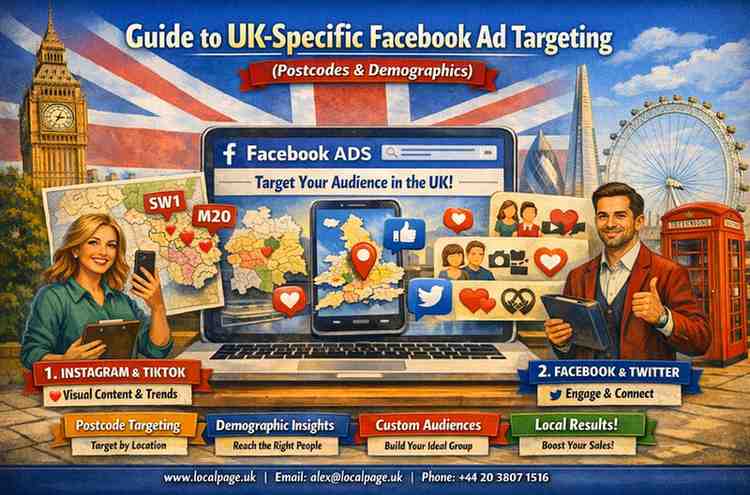
Guide to UK-specific Facebook Ad Targeting (Postcodes & Demographics)
Most UK businesses waste advertising budget by targeting audiences that never convert. Whether you run a bakery in Bristol or a trades company covering Greater Manchester, the precision of your Facebook targeting determines whether your spend generates enquiries or disappears into the ether. This guide walks you through exactly how to use postcodes, demographics, and behavioural signals to reach the right UK customers — and why smarter targeting is the foundation of effective business advertising UK campaigns.
Why UK-Specific Facebook Ad Targeting Matters in 2026
Facebook remains one of the most powerful platforms for reaching UK consumers, but the landscape has shifted dramatically. The businesses winning in 2026 are not those spending the most — they are those targeting the most precisely. Generic campaigns that cast a wide net across “all adults aged 25–55 in the UK” routinely underperform against campaigns built with postcode-level intelligence and layered demographic signals.
The reason is straightforward. UK consumers are inundated with advertising messages. The average person scrolls past hundreds of posts daily, and poorly targeted ads become invisible. When you layer postcode data, income indicators, life events, and purchase behaviours, your advert stops being noise and starts becoming relevant. This relevance is what drives clicks, enquiries, and ultimately revenue.
Facebook’s algorithm in 2026 rewards relevance over reach. A campaign targeting 15,000 precisely defined users in specific SW postcodes will often outperform a campaign targeting 500,000 broadly defined users — at a fraction of the cost per lead.
For small and medium enterprises across Britain, this is genuinely transformative. You no longer need the budget of a national brand to compete. A well-structured local campaign can deliver results that rival or exceed what larger competitors achieve with ten times the spend. The playing field has levelled, but only for those who understand the targeting tools available.
Understanding UK Postcode Targeting on Facebook
Facebook allows advertisers to target users by postcode district, which in the UK means the first part of the postcode plus the first number of the second part — for example, SW1, M1, B1. This is more granular than city-level targeting and far more useful for businesses that serve specific geographic areas. Understanding how to leverage this system is critical for any serious approach to business advertising UK.
How Postcode Districts Work in Facebook Ads Manager
Within Ads Manager, navigate to the Audience section and select “Locations.” Rather than typing a city name, you can drop individual postcode districts into the location field. Facebook will then show you the estimated audience size for each district. For example, targeting SW1W in central London might yield an audience of 8,000–12,000 people, whilst targeting PL1 in Plymouth might return 6,000–9,000.
Steps to Build a Postcode List
- Identify your service radius — typically 5, 10, or 15 miles from your business location
- Use the Royal Mail postcode finder to list all postcode districts within that radius
- Enter each district individually into Facebook’s location targeting
- Review the combined audience size and adjust by adding or removing districts
- Save this as a custom audience for reuse across campaigns
A plumbing company in Birmingham, for instance, might target B1 through B48 depending on how far their engineers travel. A private dental practice in Edinburgh might focus on EH1 through EH12. The specificity is what makes this approach powerful. You are not paying to reach people in Inverness when you only serve patients in Lothian.
Start with your top 10 postcode districts by existing customer concentration. If you do not have this data, use your delivery records or enquiry postcodes from the past 12 months. These districts almost always produce the lowest cost per acquisition.
How to Use Demographic Targeting for UK Audiences
Postcodes tell you where people are. Demographics tell you who they are. The most effective Facebook campaigns for UK businesses layer both. Facebook offers extensive demographic filters, but for UK advertisers, certain combinations are particularly powerful.
Key Demographic Filters for UK Markets
Age and gender remain foundational, but the real power lies in detailed life markers. “Parents with children under 5” is vastly more useful for a nursery in Guildford than “women aged 25–40.” “Recently moved” is gold for a removals company in Leeds. “Engaged users” (within 12 months) drives enquiries for wedding photographers in the Cotswolds. These are not generic assumptions — they are behavioural signals backed by user activity on the platform.
Income and Education Indicators
Facebook does not offer direct income targeting in the UK, but proxy filters exist. “University-educated” combined with specific postcode districts correlates strongly with household income. Professional job titles — entered in the “Job Titles” field — allow you to target directors, managers, and senior professionals. For B2B services, this is particularly valuable. An accountant in Manchester might target “Managing Director,” “Finance Director,” and “Small Business Owner” within M1–M30 postcodes.
Language and Cultural Targeting
In multicultural UK cities, language targeting can refine your reach significantly. A solicitor specialising in immigration law in Southall could target Facebook users who set their language to Urdu or Punjabi, layered over UB1 and UB2 postcodes. This combination reaches a highly relevant audience that broader targeting would miss entirely.
The most underused demographic filter in UK Facebook advertising is “Life Events.” Users who have recently changed their job, got married, or moved house are in high-spending windows. A kitchen fitter in Sheffield targeting “recently moved” within S postcodes will reach people who are statistically most likely to renovate.
Traditional vs Modern UK Advertising Approaches
For decades, UK businesses relied on local newspapers, Yellow Pages, flyers, and local radio. These channels had one thing in common: they were broadcast mediums. You paid for reach, not precision. A quarter-page advert in the Manchester Evening News reached perhaps 80,000 readers, but you had no idea how many of them were actually in the market for your services.
Modern digital advertising, particularly on Facebook, inverts this model entirely. You do not pay for impressions — you pay for results. You can set objectives around leads, messages, phone calls, or website visits. The platform optimises delivery to find the people most likely to take that action. This shift from broadcast to precision is the single most important change in online business advertising UK over the past decade.
Consider a window cleaning business in Cardiff. In the traditional model, they might spend £300 on a leaflet drop covering 5,000 households. Response rates for leaflet drops typically sit between 0.5% and 1%, meaning 25 to 50 enquiries at best. The same £300 on Facebook, targeted to CF postcodes with homeowners aged 30–65, using lead form objectives, can reliably deliver 40 to 80 qualified enquiries — with full tracking on every pound spent.
The modern approach also allows for iteration. If a campaign is not performing, you can adjust targeting, creative, or budget within hours. A leaflet drop offers no such flexibility. Once the leaflets are printed and distributed, your money is spent regardless of outcome.
Cost Breakdown: Facebook Advertising for UK Businesses
Understanding costs is essential for budgeting and expectation-setting. Facebook advertising costs in the UK vary significantly by industry, location, and objective, but the following benchmarks provide a realistic starting point for planning your business advertising packages UK internally.
Typical Cost Per Lead by Industry (2026 UK Averages)
- Home services (plumbing, electrical, roofing): £8–£18 per lead
- Professional services (accounting, legal, consulting): £15–£35 per lead
- Health and beauty (salons, clinics, aesthetics): £10–£22 per lead
- Home improvement (kitchens, bathrooms, extensions): £12–£28 per lead
- Education and training (courses, tutoring): £8–£20 per lead
- Events and entertainment (venues, experiences): £6–£15 per lead
Budget Recommendations by Business Size
Micro businesses and sole traders should start with £300–£500 per month. This allows for meaningful testing across two to three audience segments. Small to medium enterprises should budget £800–£2,000 monthly, which enables proper A/B testing of creative, copy, and audience variations. Larger local businesses aiming for dominant market presence should consider £2,500–£5,000 monthly, particularly in competitive urban markets like London, Birmingham, and Manchester.
Stopping a campaign after two weeks because “it did not work.” Facebook’s optimisation algorithm typically needs 7–14 days to learn. Premature stopping is the most frequent cause of wasted budget in UK small business advertising. Commit to a minimum 30-day test period.
Step-by-Step Strategy for UK Postcode Targeting
Having covered the theory, here is a practical framework you can implement immediately. This strategy has been refined through work with hundreds of UK businesses and represents the most reliable approach to postcode-level Facebook targeting for local business advertising UK.
Step One: Define Your Service Geography
Map your actual service area using Google Maps. Draw a radius from your business location, or if you serve an irregular area, outline the specific postcode districts. Be honest — do not target postcodes you cannot realistically serve, as this wastes budget and damages your reputation when you turn enquiries away.
Step Two: Build Your Core Audience
Enter your postcode districts into Ads Manager. Set age and gender based on your customer profile. Add relevant interest categories — for example, “home improvement” for a builder, “fitness” for a personal trainer, “pet ownership” for a groomer. Keep the audience tight: ideally 15,000–50,000 people for local campaigns.
Step Three: Layer Demographic Signals
Add life event filters, job titles, or education levels where relevant. For example, a landscape gardener in Surrey might add “homeowners” and “recently moved” over KT and GU postcodes. Each layer reduces audience size but increases relevance.
Step Four: Create Lookalike Audiences
If you have a customer list of 500 or more people, upload it to Facebook and create a 1% lookalike audience restricted to your target postcode area. This combines the targeting precision of postcodes with the behavioural intelligence of lookalike modelling.
Step Five: Test Creative Variations
Run at least three advert variations simultaneously: different images, different headline angles, different calls to action. After 7 days, review which performs best and reallocate budget accordingly.
Step Six: Install Tracking and Measure
Install the Meta Pixel on your website. Set up lead form tracking or WhatsApp click tracking within Ads Manager. Without tracking, you are guessing. With it, you can calculate your exact cost per enquiry and cost per acquired customer.
affordable business advertising UK — explore fixed-price listing packages that complement your Facebook campaigns with continuous local visibility.
GEO Targeting: Reaching UK Cities Effectively
City-level targeting seems straightforward, but UK cities present unique challenges. London, for instance, contains enormous demographic variation within a few miles. A campaign targeting “London” reaches everyone from investment bankers in Mayfair to students in Stratford. The result is an unfocused campaign that serves no one effectively.
The smarter approach is to target specific areas within cities using postcode combinations. A physiotherapy clinic in West London might target W4, W5, W6, W8, and W14 — covering Chiswick, Ealing, Hammersmith, Kensington, and West Kensington. This excludes vast swathes of London where the clinic is simply too far for patients to travel.
Regional City Strategies
For businesses in regional cities — Birmingham, Leeds, Glasgow, Bristol, Newcastle, Sheffield, Liverpool, Nottingham, and others — the approach is slightly different. These cities are more compact, and postcode targeting can often cover the entire urban area with fewer districts. A restaurant in Bristol city centre might only need BS1, BS2, BS3, and BS8 to reach its core market.
For businesses serving broader counties rather than single cities — a roofing company covering all of Hampshire, for example — the strategy shifts to targeting all relevant postcode districts across the county. This can mean entering 30 to 50 individual districts, which is tedious but worthwhile. Save these as a saved audience for efficiency.
Facebook is increasingly integrating map-based radius targeting with postcode specificity. Expect to see tools that let you draw a polygon on a map and automatically include all postcode districts within that shape, removing the need for manual entry.
How to Avoid Common Facebook Ad Targeting Mistakes
Even experienced advertisers make targeting errors that bleed budget. The following mistakes are particularly common among UK businesses and are worth understanding as part of any comprehensive approach to business advertising services UK.
Overlapping Audiences
Running multiple ad sets that target overlapping postcode areas without using audience exclusions. If Ad Set A targets SW1–SW5 and Ad Set B targets SW3–SW10, users in SW3–SW5 see both. This drives up costs through auction competition with yourself. Always check the “Audience Overlap” tool in Ads Manager.
Neglecting Exclusions
Failing to exclude your existing customer list from acquisition campaigns. If you have 2,000 past customers in your database and your campaign targets their postcode areas, you will pay to reach people who have already bought from you. Exclude them, or create a separate retargeting campaign with different messaging.
Too Broad Interest Targeting
Selecting “shopping” as an interest reaches over 200 million people globally, including the UK. This is essentially untargeted. Use specific interests — “John Lewis,” “IKEA,” “Made.com” — which indicate purchase intent relevant to your product or service.
Ignoring Mobile-First Behaviour
Over 90% of UK Facebook users access the platform via mobile. If your landing page is not mobile-optimised, your targeting precision is wasted. Users click, see a page they cannot navigate, and leave. Check your mobile load speed and ensure forms are simple enough to complete on a phone screen.
Targeting postcodes where you have no credibility signals. If someone in your targeted area searches for your business name and finds nothing — no reviews, no directory presence, no website — they will not enquire regardless of how well-targeted your advert was. Build your digital footprint in tandem with your advertising.
Voice Search Optimisation for UK Ad Campaigns
Voice search is no longer a novelty. Millions of UK residents regularly use Siri, Google Assistant, and Alexa to find local services. “Find a plumber near me,” “Where is the nearest dental practice,” and “Book a table in Bath tonight” are spoken queries that trigger local search results. While Facebook ads do not directly respond to voice queries, the ecosystem is connected.
When a voice search returns a result — your Google Business Profile, your website, or your directory listing — the user often visits that page. If you have the Meta Pixel installed on that page, Facebook can retarget that visitor with a tailored advert. This creates a powerful loop: voice search drives discovery, Facebook retargeting drives conversion.
To maximise this, ensure your business information is consistent across all platforms. Your name, address, phone number, and postcode must match exactly on your website, Google Business Profile, Facebook page, and any directory listings. Inconsistencies confuse both search engines and potential customers, reducing the effectiveness of both voice search and paid advertising.
For businesses wondering how to increase local visibility for my business UK, the combination of voice-search-optimised profiles and retargeted Facebook campaigns is one of the most effective strategies available in 2026.
AI SEO and Semantic SEO in UK Ad Targeting
Artificial intelligence has transformed how Facebook targets users and how search engines understand your business. Semantic SEO — the practice of building content around topics and entities rather than individual keywords — directly impacts your Facebook advertising performance in ways many businesses do not realise.
When your website, blog content, and social profiles demonstrate topical authority around your services and location, Facebook’s algorithm interprets your page as more relevant to users in that area. A roofing company in Liverpool whose website thoroughly covers flat roofing, pitched roofing, tile replacement, chimney repair, and Liverpool-specific building regulations will be served to more relevant users than a competitor with thin, generic content.
AI tools now allow businesses to generate this semantic content at scale, but the quality must remain high. Google and Facebook are both adept at detecting low-value, AI-generated content that adds nothing new. The businesses winning in 2026 use AI to accelerate content production but maintain editorial quality through human review and genuine expertise.
Practical Semantic SEO Steps for UK Advertisers
- Create location-specific service pages (e.g., “Roofing Services in Liverpool” rather than just “Roofing Services”)
- Write blog posts answering questions your customers actually ask
- Include local landmarks, areas, and references naturally in your content
- Ensure your Facebook page description includes your services and location clearly
- Build internal links between related content on your website
Facebook’s AI in 2026 analyses the content of landing pages, not just keywords. If your advert mentions “emergency plumbing in Bristol” but your landing page is a generic homepage with no mention of Bristol or emergency services, the algorithm will reduce delivery because the page does not match the advert promise. Alignment matters.
Conversion Strategy for UK Facebook Ad Campaigns
Targeting gets the right people to see your advert. Conversion strategy turns those views into paying customers. Many UK businesses invest heavily in targeting but neglect the conversion infrastructure, which is akin to spending thousands on shopfront signage but leaving the door locked.
The Lead-to-Customer Pathway
For service businesses, the most effective conversion pathway in 2026 is: Facebook advert → lead form or WhatsApp message → immediate response → qualification call → booking. Speed of response is critical. Research consistently shows that enquiries contacted within 5 minutes are 21 times more likely to convert than those contacted after 30 minutes.
Landing Page Essentials
If you drive traffic to a website rather than using lead forms, your landing page must include: a clear headline matching the advert, a visible phone number, a simple enquiry form (maximum 4 fields), trust signals (reviews, certifications, accreditations), and location proof (your address, a map, local imagery). Every element should reassure the visitor that they have found a legitimate, local business capable of solving their problem.
Retargeting for Warm Audiences
Not everyone enquires on first contact. Build retargeting campaigns for people who visited your landing page but did not enquire. Use different creative — perhaps a testimonial video or a limited-time offer. These warm audiences typically convert at 3 to 5 times the rate of cold audiences, making retargeting one of the highest-ROI activities in digital business promotion UK.
Ready for a platform that works alongside your Facebook campaigns?
Local Page UK provides continuous visibility across UK cities, ensuring that when your Facebook ads drive discovery, potential customers find a credible, established business presence waiting for them.
Mini Case Study: UK Small Business Success
The Business
A independent landscaping company based in Woking, Surrey, offering garden design, turfing, fencing, and seasonal maintenance. Annual revenue approximately £180,000, with growth stagnating for two years.
The Challenge
Previous advertising consisted of occasional Facebook boosts (no targeting strategy) and a yearly £600 leaflet drop. Cost per enquiry was estimated at £35–£40, and the business owner could not determine which marketing activity was actually generating results.
The Strategy
We implemented a structured Facebook campaign targeting GU21, GU22, GU23, and GU24 postcode districts. Demographic layers included “homeowners,” aged 35–65, with interests in “gardening,” “home improvement,” and “BBC Gardeners World.” Three creative variations were tested: a portfolio image carousel, a before-and-after video, and a customer testimonial graphic.
The Results (90 Days)
- Total spend: £1,350 across 90 days (£450 per month)
- Total enquiries received: 87 qualified leads
- Cost per lead: £15.51 (down from an estimated £35–£40)
- Leads converted to paying jobs: 31
- Revenue from converted jobs: £47,500
- Return on ad spend: 35:1
Key Takeaway
The improvement did not come from spending more. It came from targeting more precisely, testing creative systematically, and responding to enquiries within minutes. The business owner described the difference as “going from throwing darts in the dark to using a laser pointer.”
2026 Trends in UK Facebook Advertising
Staying ahead of platform changes gives you a competitive advantage. The following trends are shaping how UK businesses approach Facebook advertising in 2026 and should inform your planning for digital business advertising UK.
Rise of WhatsApp as a Conversion Channel
Meta has deeply integrated WhatsApp with Facebook advertising. Click-to-WhatsApp adverts now represent one of the highest-converting ad formats for UK service businesses. Users prefer messaging over calling or filling in forms, and WhatsApp conversations have a significantly higher conversion rate than traditional lead forms. If your business is not using WhatsApp as a conversion channel, you are leaving results on the table.
AI-Powered Creative Generation
Facebook now offers AI tools that generate advert copy, suggest images, and create video variations from static assets. These tools are improving rapidly, but the best results come from using AI to accelerate production of human-directed creative, not replacing human creativity entirely. Use AI for format variations; use human insight for messaging strategy.
Privacy-First Targeting
With ongoing privacy regulations and tracking limitations, first-party data has become more valuable than ever. Businesses that collect customer emails, phone numbers, and enquiry data — and use these to build custom and lookalike audiences — will maintain targeting precision as third-party signals degrade. If you are not systematically collecting first-party data, start now.
Short-Form Video Dominance
Reels and short-form video content continue to outperform static images in engagement and conversion metrics. A 15-second video of a tradesperson at work, a treatment being performed, or a product being used will almost always outperform a polished studio photograph. Authenticity beats production value on Facebook in 2026.
Augmented reality (AR) try-on experiences within Facebook adverts are moving beyond fashion and cosmetics. Home improvement businesses can now let users “place” furniture, kitchen designs, or landscaping features in their own space directly from the advert, dramatically increasing engagement and purchase intent.
Beyond Facebook: Alternative Advertising Solutions for UK SMEs
Facebook is powerful, but relying on a single channel is risky. Algorithm changes, account restrictions, or increased competition can overnight reduce your campaign effectiveness. The most resilient UK businesses build multi-channel visibility, and this is where understanding UK business advertising solutions beyond social media becomes essential.
Directory and Listing Platforms
Business directory listings provide continuous, passive visibility that complements active Facebook advertising. When your Facebook advert drives someone to search for your business, they should find a robust presence across multiple platforms — not just a bare Facebook page. Directory listings build credibility, provide backlinks for SEO, and capture organic search traffic that you would otherwise lose to competitors.
Google Business Profile
Your Google Business Profile is the single most important free listing for any UK local business. It appears in Google Maps results, local search results, and Google SERPs directly. Ensure it is fully completed with photos, services, opening hours, and regular review solicitation.
Industry-Specific Platforms
Depending on your sector, specialised platforms can deliver exceptional ROI. Tradespeople benefit from Checkatrade and Rated People. Hospitality businesses need TripAdvisor and OpenTable. Professional services should consider LinkedIn. The key is presence, not necessarily paid promotion — being findable on these platforms builds the trust foundation that makes your Facebook ads more effective.
sponsored business advertising UK — discover how sponsored listings on Local Page UK boost your visibility in targeted UK cities alongside your Facebook campaigns.
Final Action Plan for UK Business Growth
Everything covered in this guide is actionable. Here is the sequence to follow if you want to transform your Facebook advertising from an uncertain expense into a reliable lead generation system. This is the best way to approach business advertising UK for sustainable results.
Week One: Foundation
Audit your current Facebook page, ensure your business information is complete and accurate, install the Meta Pixel on your website, and set up WhatsApp Business if you have not already. These are non-negotiable prerequisites.
Week Two: Audience Building
Research your postcode districts, build your saved audience in Ads Manager, upload your customer list for a custom audience, and create a 1% lookalike audience. Document your targeting decisions so you can replicate what works.
Week Three: Creative Production
Create three advert variations: one video, one image carousel, and one testimonial or offer graphic. Write two headline options for each. Ensure every advert clearly states what you do, where you are, and what action the user should take.
Week Four: Launch and Learn
Launch your campaign with a lead or WhatsApp objective. Set a daily budget you can sustain for 30 days minimum. Check performance every three days but do not make changes in the first seven. After two weeks, review and optimise based on data.
Ongoing: Iterate and Expand
Once you have a winning formula, gradually increase budget. Test new postcode areas. Build retargeting campaigns. Add directory listings for credibility. The goal is a system where every pound spent produces a measurable, profitable return.
The businesses that thrive in 2026 are not the ones with the biggest budgets. They are the ones with the most disciplined processes. Postcode targeting, demographic layering, creative testing, and conversion infrastructure — applied consistently — will outperform sporadic, unfocused spending every single time. Whether you are a sole trader in Exeter or a growing company in Glasgow, the framework remains the same. The difference is in the execution.
Frequently Asked Questions
How do I target specific UK postcodes on Facebook?
In Ads Manager, go to the Audience section, select Locations, and type individual postcode districts (like SW1, M3, B5) directly into the field. Facebook will estimate the reachable audience for each district. Save the combination as a custom audience for future campaigns.
What is the minimum budget for Facebook ads in the UK?
Facebook technically allows daily budgets as low as £1, but for meaningful results in UK local markets, expect to spend at least £10–£15 per day per ad set. A monthly budget of £300–£500 is a realistic starting point for testing.
Can I target multiple UK cities in one campaign?
Yes, but be cautious. Targeting London and Glasgow in the same campaign means your audience has very different characteristics, costs, and competition levels. Separate campaigns by region almost always perform better than one combined campaign.
How accurate is Facebook postcode targeting?
Facebook determines location from profile data, device signals, and IP addresses. It is not perfectly precise — users near postcode boundaries may appear in adjacent districts — but for local campaigns it is accurate enough to deliver strong results. Expect roughly 80–90% accuracy at district level.
Should I use lead forms or send traffic to my website?
Both work. Lead forms typically generate more enquiries at a lower cost because they keep users within Facebook. Website traffic is better if you have a strong landing page and want to retarget visitors. Many successful UK advertisers use both in parallel.
How long before Facebook ads start working?
The learning phase typically takes 7 to 14 days. During this period, performance fluctuates as the algorithm gathers data. Do not judge a campaign on fewer than 7 days of data, and ideally commit to a full 30-day test before making significant changes.
What type of content works best for UK Facebook ads?
Short, authentic video outperforms polished static images in 2026. Show real work being done, real customers, real results. Add captions because most UK users watch videos with sound off. Pair video with a clear, specific call to action.
Can I exclude competitors from seeing my Facebook ads?
You can exclude specific page names from your audience, but this only prevents people who have liked those pages from seeing your adverts. You cannot prevent competitors from seeing your ads entirely, and attempting to do so is generally not worth the effort.
Is Facebook advertising still effective for UK small businesses?
Yes, but the approach has changed. Broad, untargeted campaigns no longer work well. Precision targeting using postcodes, demographics, and retargeting is essential. Small businesses that invest in proper targeting strategy consistently achieve strong returns.
Where can I find alternative advertising options beyond Facebook?
Business directory platforms like Local Page UK provide continuous local visibility across UK cities. Combining directory listings with Google Business Profile optimisation and targeted Facebook advertising creates a resilient, multi-channel approach that does not depend on any single platform.
Stop Wasting Budget. Start Targeting Smartly.
The difference between a Facebook campaign that generates leads and one that drains your budget comes down to targeting precision and conversion infrastructure. If you are ready to build a system that delivers measurable enquiries from UK customers, we can help — whether through Facebook strategy, directory visibility, or a combined approach tailored to your business.
 LocalPage UK Health & Wellness Directory
Leave a comment